
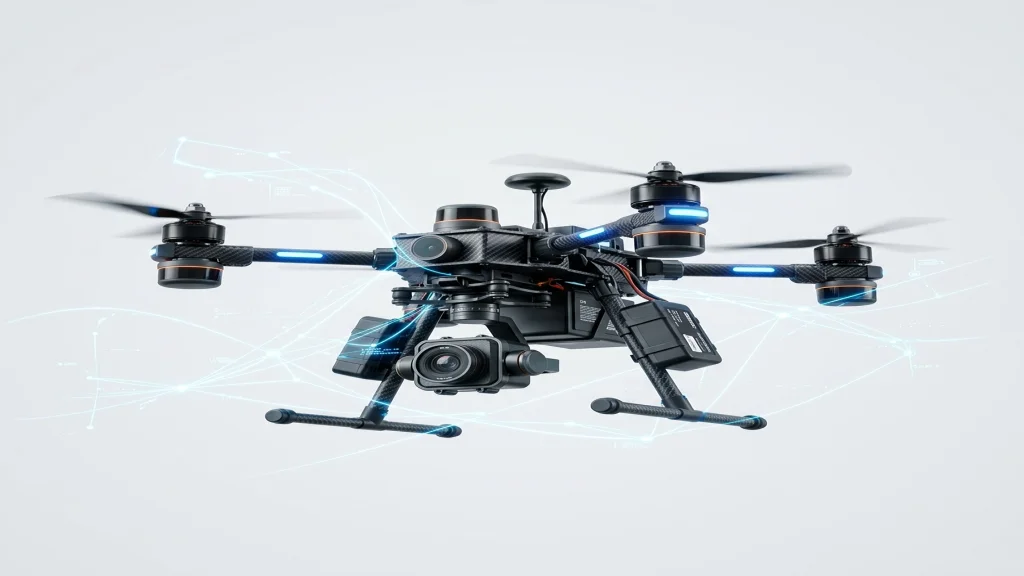
Understanding Quadcopter Physics
Unlike traditional fixed-wing aircraft that rely on forward speed to generate wing lift, quadcopters use four independent motor-propeller assemblies to achieve hovering, roll, pitch, and yaw movements. This makes them ideal platforms for physics and aerodynamics education.
Bernoulli's Principle and Propeller Aerodynamics
A drone propeller is essentially a rotating airfoil. The curved upper surface accelerates airflow, reducing static pressure relative to the flat bottom surface. This pressure differential generates upward thrust that balances gravitational weight.
Why Quadcopters Use Counter-Rotating Motors
Newton's Third Law states that every action generates an equal and opposite reaction. If all four motors spun clockwise, the drone chassis would violently spin counter-clockwise. By pairing two clockwise (CW) motors with two counter-clockwise (CCW) motors, torque forces cancel each other out, allowing stable orientation.
Responsible Aviation & DGCA Safety Standards
At STEMix Academy, every drone session begins with flight safety: maintaining visual line-of-sight, respecting no-fly airport zones, using propeller guards, and understanding India's Directorate General of Civil Aviation (DGCA) guidelines.